

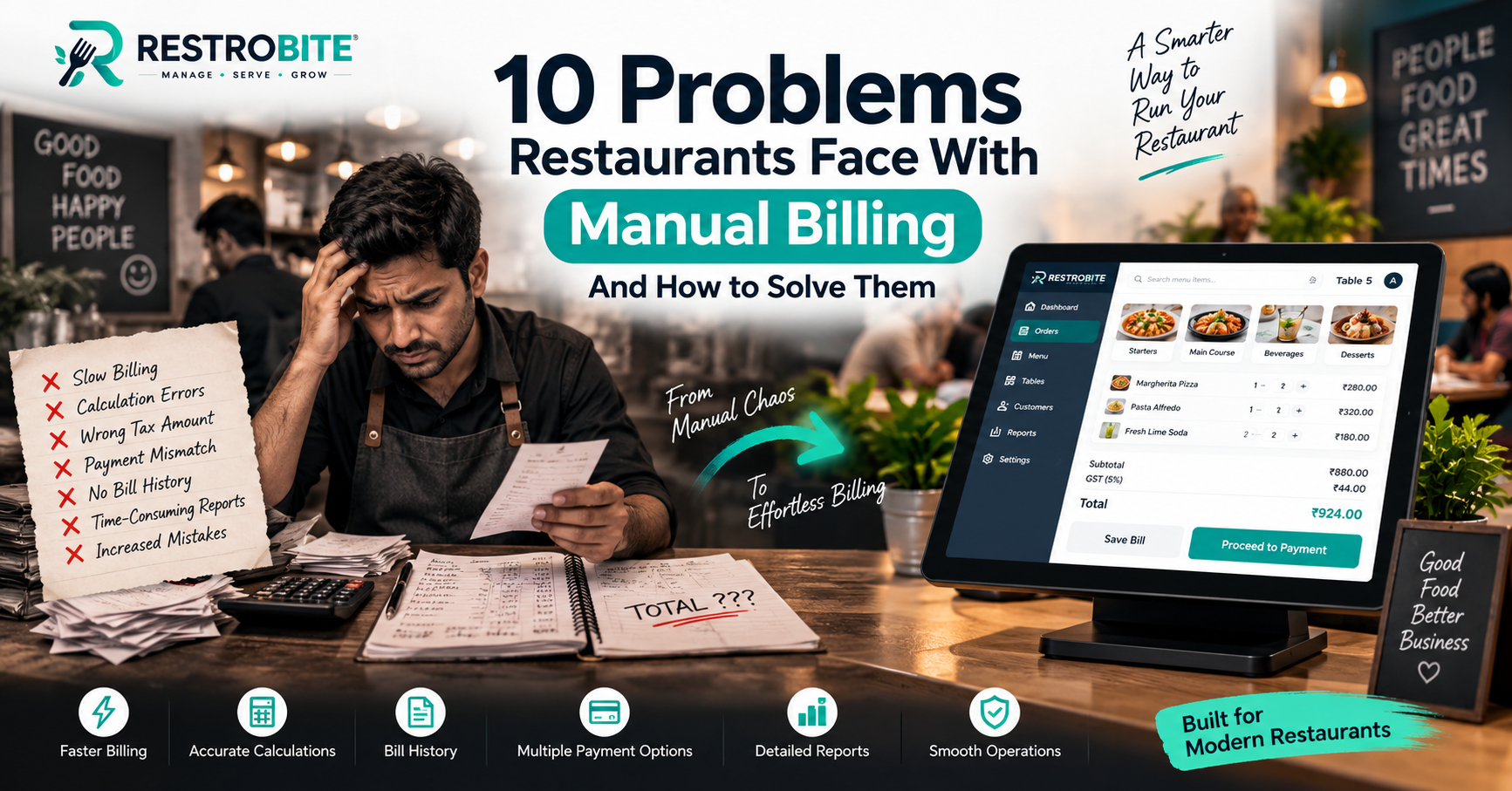
Running a restaurant involves much more than serving great food. During busy hours, every order, payment, discount, tax calculation, and bill needs to be handled accurately and quickly.
For restaurants still relying on handwritten bills, calculators, spreadsheets, or disconnected systems, billing can become one of the biggest operational challenges.
A small billing mistake may seem harmless, but repeated errors can lead to customer complaints, payment discrepancies, revenue leakage, and hours of unnecessary administrative work.
Here are 10 common problems restaurants face with manual billing and how modern restaurant billing software can help solve them:
1. Slow Bill Generation During Busy Hours
The dinner rush can turn billing into a bottleneck.
When staff have to manually calculate item prices, taxes, discounts, and the final amount, generating each bill takes additional time. When several customers are waiting to pay at the same time, these delays can quickly affect the overall customer experience.
A restaurant billing system can automatically calculate the bill based on the items added to an order, reducing manual calculations and helping staff complete checkout faster.
2. Manual Calculation Errors
One of the biggest risks of manual billing is simple human error.
A cashier may accidentally:
- Enter the wrong quantity
- Add the wrong item price
- Forget an item
- Calculate the total incorrectly
- Apply the wrong discount
- Enter the wrong tax amount
Even a small mistake can create a difference between the amount that should have been collected and the amount actually received.
Automated billing reduces the number of calculations staff need to perform manually, ensuring complete consistency across every transaction.
3. GST and Tax Calculation Can Become Complicated
Restaurants need to apply the appropriate taxes to their bills based on their configuration and business requirements.
With manual billing, staff may need to calculate taxes separately or rely on calculators and spreadsheets. This increases the possibility of incorrect calculations.
A properly configured billing system can automatically apply the configured tax rates while generating the bill. This makes the billing process more consistent and reduces repetitive manual work.
4. Discounts Can Lead to Billing Mistakes
Discounts are common in restaurants, but manually calculating them can create confusion.
For example, staff may accidentally:
- Apply a discount twice
- Calculate the wrong percentage
- Apply a discount to the wrong items
- Forget to include the discount in the final calculation
When discounts are handled through a billing system, the calculation can be performed automatically instead of relying on manual arithmetic.
5. Finding Previous Bills Becomes Difficult
Imagine a customer comes back and asks for a copy of their previous bill.
If the restaurant stores bills in physical files or scattered spreadsheets, finding a specific transaction can take considerable time.
A digital billing system can maintain bill history so authorized staff can quickly locate previous transactions and reprint or review them when required. This is particularly useful for restaurants that process a large number of orders every day.
6. Cash and UPI Payments Can Get Mismatched
Modern restaurants often accept multiple payment methods, including cash, UPI, cards, and other methods.
When payments are recorded manually, it can become difficult to determine exactly how much was collected through each payment method.
Common Reconciliation Example:
Expected cash: ₹18,500
Actual cash: ₹17,900
Where did the ₹600 difference come from? Without proper transaction records, investigating such discrepancies can be difficult.
A restaurant POS can record payment methods against individual orders and provide transaction information that makes reconciliation easier.
7. Daily Sales Calculation Takes Too Much Time
At the end of every day, restaurant owners need answers to basic questions:
- How much did we sell today?
- How many orders did we receive?
- Which items sold the most?
- How much was collected in cash?
- How much was collected digitally?
When this information is maintained manually, someone may have to calculate totals from bills, registers, or spreadsheets.
With digital sales records, these figures can be generated from the transactions already recorded in the system.
8. Communication Between Waiters and Kitchen Can Break Down
Billing problems don't always begin at the billing counter.
A restaurant order typically moves through several stages: Order → Kitchen → Preparation → Billing → Payment.
If orders are written manually and communication between the waiter and kitchen is unclear, items can be missed, duplicated, or prepared incorrectly.
A connected restaurant POS and KOT workflow can send order information to the kitchen and keep the order process connected with billing. RESTROVA's planned POS workflow follows this same operational flow, with KOT generation connected to the kitchen and billing process.
9. End-of-Day Reporting Becomes a Manual Task
Restaurant owners shouldn't have to spend hours after closing the restaurant preparing basic reports.
Manual records often require staff to collect information from multiple sources before preparing a daily summary.
A restaurant management system can provide reports based on recorded transactions, including sales, orders, payments, products, inventory, staff, and expenses. This gives owners a clearer picture of what happened during the day. RESTROVA's planned Restaurant Panel includes dedicated Sales, Order, Payment, Product, Inventory, Staff, Expense, and Profit & Loss reporting.
10. Manual Systems Become Difficult to Manage as the Restaurant Grows
A manual process may work when a restaurant has a small number of daily orders. But as order volume increases, managing hundreds of transactions manually becomes increasingly difficult.
More orders mean: More bills → More calculations → More records → More chances for errors.
This is where restaurant billing software becomes more valuable. Instead of treating billing as a separate activity, a POS system can connect ordering, KOT, billing, payments, and reporting into one operational workflow.
How Restaurant Billing Software Solves These Problems
A modern restaurant billing system can help centralize several important processes:
- Faster Billing: Create itemized bills without manually calculating every amount.
- Automated Calculations: Reduce errors in totals, taxes, quantities, and discounts.
- Bill History: Keep previous transactions organized and easier to find.
- Payment Recording: Record payments according to the selected payment method.
- Connected KOT & Billing: Keep the order lifecycle connected from order-taking to billing.
- Sales Reports: Get a clearer view of daily and periodic restaurant performance.
- Better Operational Control: Give restaurant owners and managers better visibility into day-to-day transactions.
Manual Billing vs Restaurant Billing Software
| Manual Billing | Restaurant Billing Software |
|---|---|
| Manual calculations | Automated calculations |
| Higher chance of calculation errors | Consistent calculations |
| Physical/scattered records | Centralized bill history |
| Manual sales calculation | Automated sales reports |
| Difficult payment reconciliation | Payment records by method |
| Slower during busy hours | Faster checkout workflow |
| Separate order and billing processes | Connected order-to-bill workflow |
| Difficult to scale | Designed for higher transaction volumes |
When Should a Restaurant Move to Billing Software?
There isn't a single number of orders that determines when a restaurant needs software. However, if your team regularly experiences:
- Long queues at the billing counter
- Incorrect bills
- Payment mismatches
- Difficulty finding old bills
- Time-consuming daily calculations
- Order communication problems
- Manual sales reporting
then it may be time to move from manual billing to a dedicated restaurant billing system.
Final Thoughts
Manual billing may appear simple when a restaurant is small, but the problems become more visible as order volume and operational complexity increase.
Faster billing, accurate calculations, organized transaction records, connected KOT workflows, payment tracking, and sales reporting can make everyday restaurant operations significantly easier.
For restaurant owners looking to reduce manual work and gain better control over their operations, a modern restaurant billing and POS system can be an important step toward a more organized restaurant.